MY ROLE
I was brought on as a UX subject matter expert and consultant to oversee the strategy and design for this project. My team consisted of a business analyst, marketing expert and an agile development team. Additionally, we were able to partner with outside resources to execute detailed usability testing.
The CHALLENGE
Joining the bone marrow donor registry was a tedious process that required abundant data collection. The legacy online application consisted of 50+ steps to register. The UX challenge was to simplify and streamline the process with the goal of decreasing time invested and increasing sign up conversions.
The Opportunity
Be The Match is an organization that values research in all forms. The library of market research conducted prior to my arrival is astonishing. It took weeks to digest and synthesize insights from the vast portfolio of research they had available. What the research shows is that there is a specific group of potential donors that are needed - but are difficult to recruit and register. While traffic to the online registration process was strong, conversions were low. The assumption was that if we could increase overall website registration numbers, we would inherently increase conversions for this hard-to-reach demographic.
The Strategy
Architecture Audit
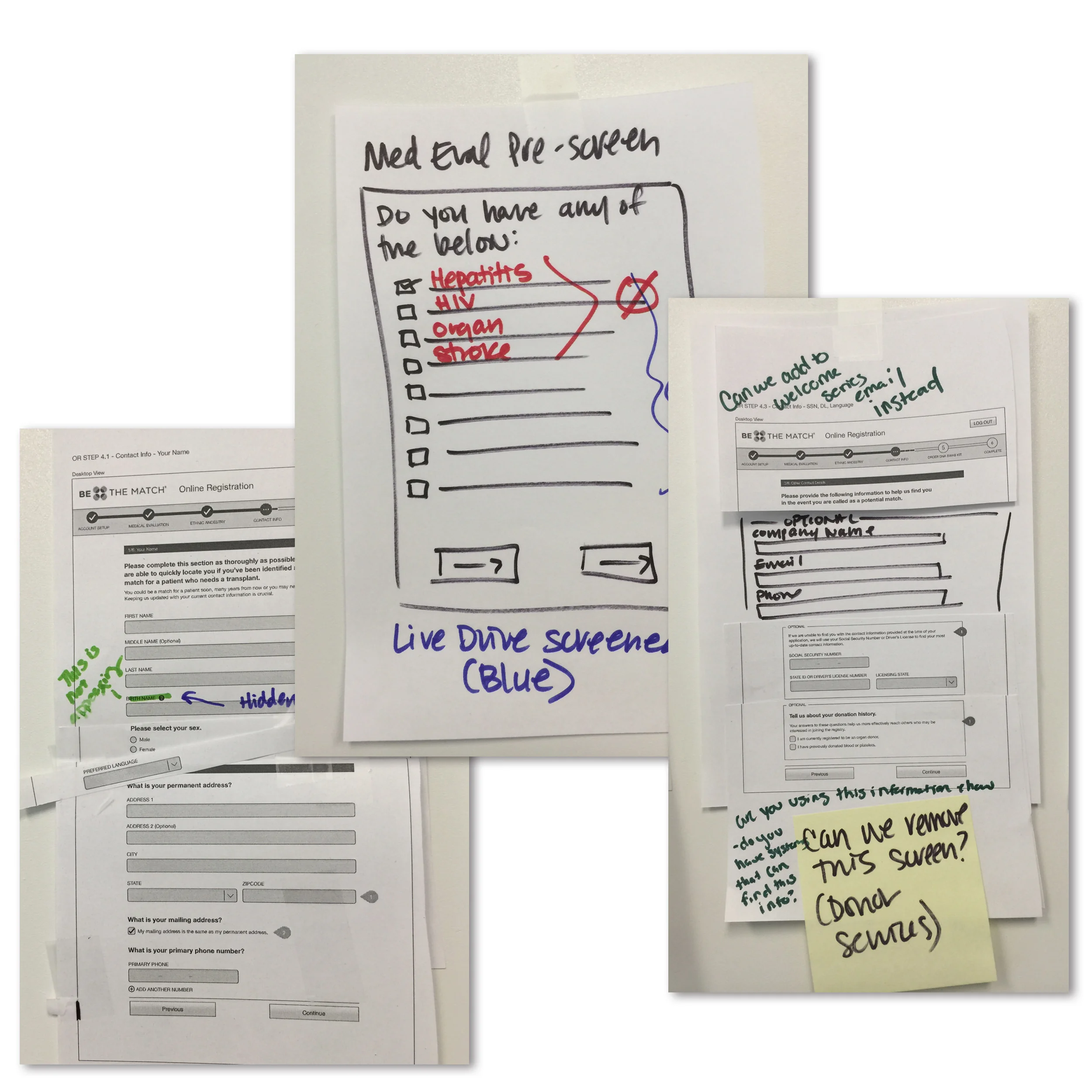
The team began by carefully reviewing the existing registration process. Internal interviews were conducted with subject matter experts as well as the legal team to fully understand registration form requirements.
Once the audit was completed, loose requirements were defined (think whiteboard list). Next, we quite literally deconstructed the registration process step-by-step, one component at a time. By literally slicing and dicing the forms, we were able to re-build the registration process in a logical way and iron out kinks that appeared over time through constant form enhancement.
Prototype Build
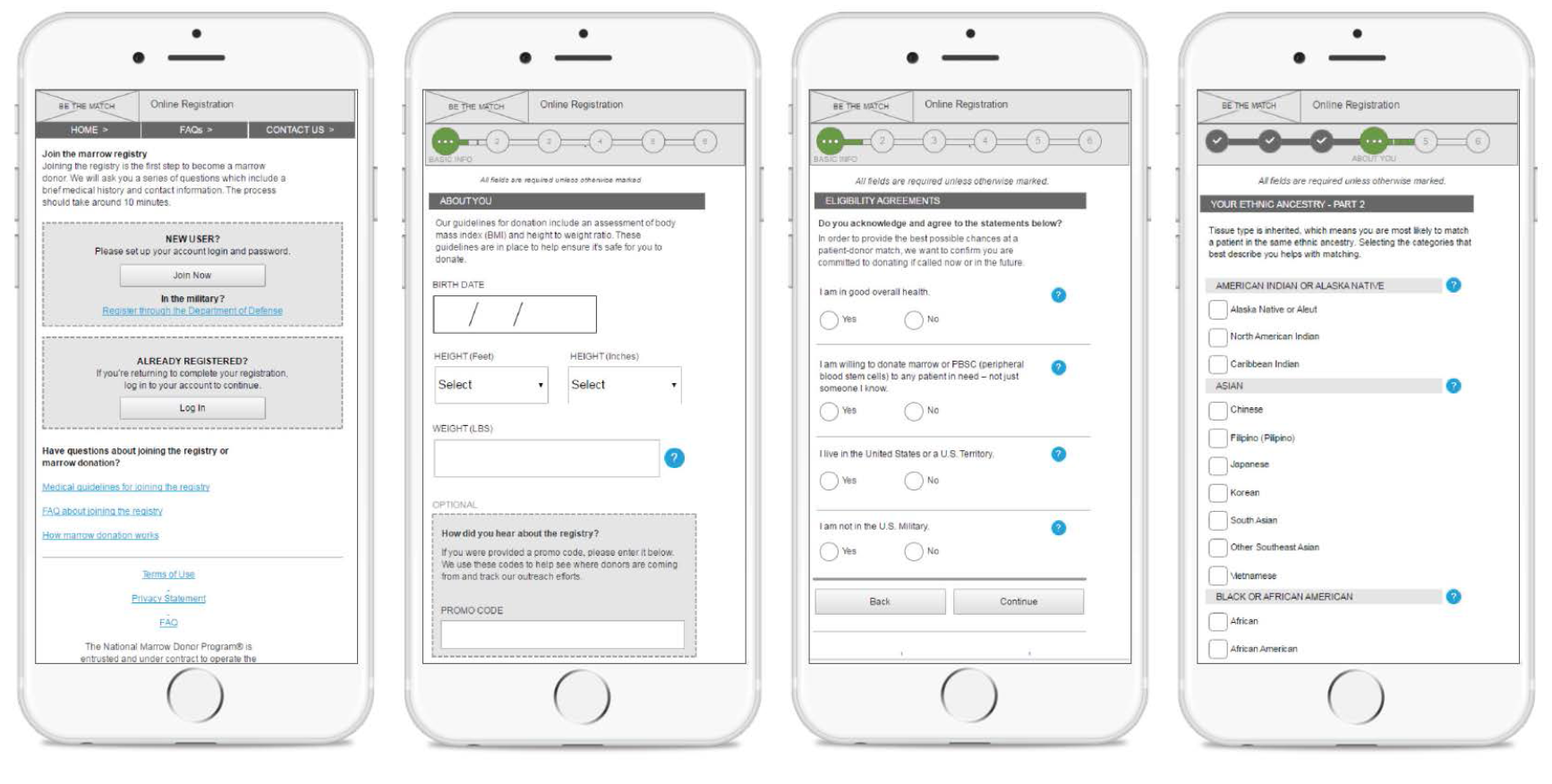
Once the registration process was put back together, an Axure prototype was built with the intention to test the end-to-end registration process with real users. This testing would serve as baseline research for future iterative testing.
The resulting prototype (pictured below) was a low-fidelity, high-functioning prototype. The registration process was condensed into 20 steps, a considerable change from the original 50+ step process.
User Testing
Prototype testing was conducted with twelve representative users. Recruitment focused on finding users that represented the core young male demographic.
What the research found was that most users could easily register to be a donor in less than 10 minutes, which was less than half the time it was previously taking users to complete the old form.
Further, our research uncovered that this particular group of users was likely to be filling out this complex form while also being in a distracted environment (such as riding in a car with friends).
The Solution: A Simplified registration process to become a bone marrow donor.
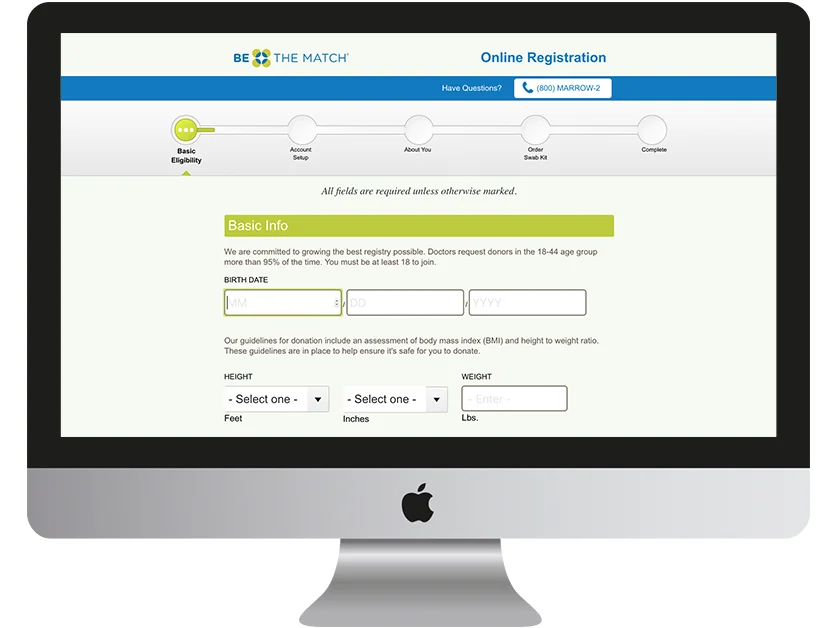
After implementing changes based on initial user testing, the registration process had been condensed from it’s original 53-step process into a 15-20 step process. Conditional logic was added to the form back-end to only show questions deemed necessary based on a user’s inputs.
Project Status
I was brought on to this project to manage the strategic direction, architecture, testing and build requirements. A follow-up after the conclusion of our project showed that the new form had been implemented and had considerably increased successful website registrations.